
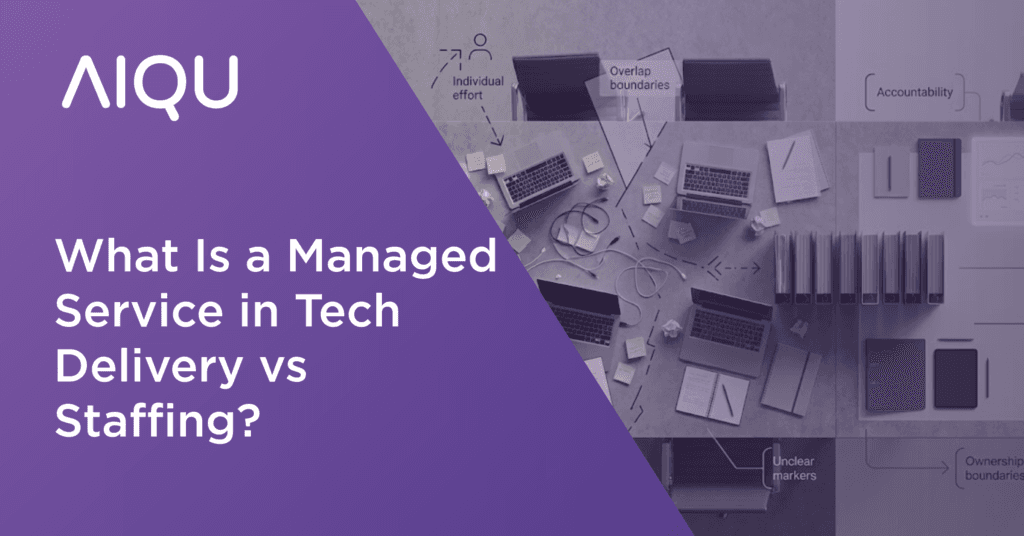
What Is a Managed Service in Tech Delivery vs Staffing?
As technology teams scale, many leaders default to a familiar solution: hire more people. Contractors, consultants, developers, engineers. The assumption is simple. More hands will equal more output.
This is where many tech delivery models quietly break down.
Staffing adds capacity. Managed services add accountability. The difference is not contractual. It is operational.
Understanding that distinction is critical for CTOs, CIOs, and delivery leaders who are under pressure to move faster without losing control.
Why staffing alone starts to fail at scale
Traditional tech staffing is designed to solve one problem: access to talent. You need developers, testers, architects, or engineers, and a provider supplies them. Responsibility for delivery, prioritization, quality, and outcomes remains internal.
This model works when teams are small, scopes are stable, and leadership bandwidth is available.
It starts to fail when delivery becomes complex.
As projects scale, leaders discover that managing individuals across vendors, timelines, and dependencies takes more effort than expected. Velocity slows. Quality becomes inconsistent. Accountability blurs. The organization is busy, but outcomes are uneven.
This is not a people problem. It is a delivery model problem.
What a managed service actually means in tech delivery
A managed service in tech delivery shifts the focus from people to outcomes.
Instead of supplying individual resources, the provider takes responsibility for a defined scope of work. This includes delivery planning, team structure, performance management, quality control, and reporting. The client defines what needs to be achieved. The managed service partner owns how it gets delivered.
The key difference is ownership.
In a managed service model, delivery risk does not sit entirely with the client. It is shared, structured, and governed.
This is why managed services are not interchangeable with staffing, even if both involve people working on your technology.
Staffing versus managed services: the real differences
The easiest way to understand the difference is to look at where accountability sits.
In a staffing model, the provider supplies talent. The client manages delivery. Success depends heavily on internal leadership capacity, coordination, and oversight.
In a managed service model, the provider owns delivery against agreed outcomes. The client governs, reviews, and aligns priorities, but does not micromanage execution.
This distinction matters most when things go wrong.
When a staffed resource underperforms, the client absorbs the impact. When a managed service underdelivers, the provider is accountable to fix it.
That difference changes behavior, incentives, and results.
Why managed services reduce delivery risk in tech programs
Tech delivery rarely fails because of a lack of skill. It fails because of fragmentation.
Multiple vendors. Distributed teams. Unclear ownership. Shifting priorities. Poor handoffs.
Managed services reduce this fragmentation by consolidating responsibility. Teams operate under a single delivery framework. Metrics are consistent. Escalations are structured. Risks are identified early instead of surfacing late as missed deadlines or quality issues.
For leadership, this means fewer surprises and more predictable outcomes.
When staffing still makes sense
This does not mean staffing is obsolete.
Staffing works well when you need short-term capacity, niche expertise, or temporary augmentation for a stable team. It is effective when scope is clear and delivery ownership is already strong internally.
Problems arise when organizations use staffing to solve delivery problems it was never designed to handle.
When leaders expect staffed teams to self-organize, self-correct, and self-deliver without added structure, disappointment follows.
When managed services become the smarter choice
Managed services are most effective when delivery matters more than headcount.
This includes product development, platform modernization, data and analytics programs, cybersecurity operations, and large-scale transformation initiatives. In these scenarios, outcomes, timelines, and quality are critical, and leadership cannot afford constant oversight.
Managed services give leaders leverage. Instead of managing individuals, they manage performance at a system level.
That shift is often the difference between controlled execution and ongoing firefighting.
How AIQU approaches managed tech delivery
At AIQU, we see organizations struggle not because they lack talent, but because they lack delivery structure.
Our managed services approach is built around accountability, not headcount. We design delivery teams aligned to outcomes, manage performance end to end, and integrate with client governance models so visibility is maintained without adding operational burden.
The goal is not to replace internal teams. It is to remove delivery friction so technology leaders can focus on strategy instead of coordination.
A final perspective for technology leaders
If your tech delivery feels slow despite having the right people, the issue is rarely talent. It is how delivery responsibility is structured.
Staffing gives you resources. Managed services give you outcomes.
Choosing between them is not about cost alone. It is about how much delivery risk your organization is prepared to carry.
The most effective tech leaders are not asking how many people they need. They are asking who owns delivery, and how clearly that ownership is defined.
That question determines whether technology enables growth or quietly holds it back.
FAQs: Managed Services vs Staffing in Tech Delivery
What is a managed service in tech delivery?
A managed service in tech delivery is a model where a provider owns the delivery of a defined technology scope, including planning, execution, quality, and outcomes, rather than just supplying individual resources.
How is a managed service different from tech staffing?
Tech staffing provides people, while managed services provide outcomes. In staffing, the client manages delivery. In managed services, the provider is responsible for delivery performance.
When should companies choose managed services over staffing?
Companies should choose managed services when delivery outcomes, timelines, and quality matter more than simply adding capacity.
Is managed services more expensive than staffing?
Managed services often look more expensive upfront, but they reduce hidden costs related to delays, rework, coordination effort, and delivery failures.
Does managed services replace internal tech teams?
No. Managed services complement internal teams by taking ownership of defined delivery scopes while internal leaders retain strategic control.
Who is accountable when delivery issues occur in a managed service model?
In a managed service model, the service provider is accountable for resolving delivery issues and meeting agreed performance metrics.