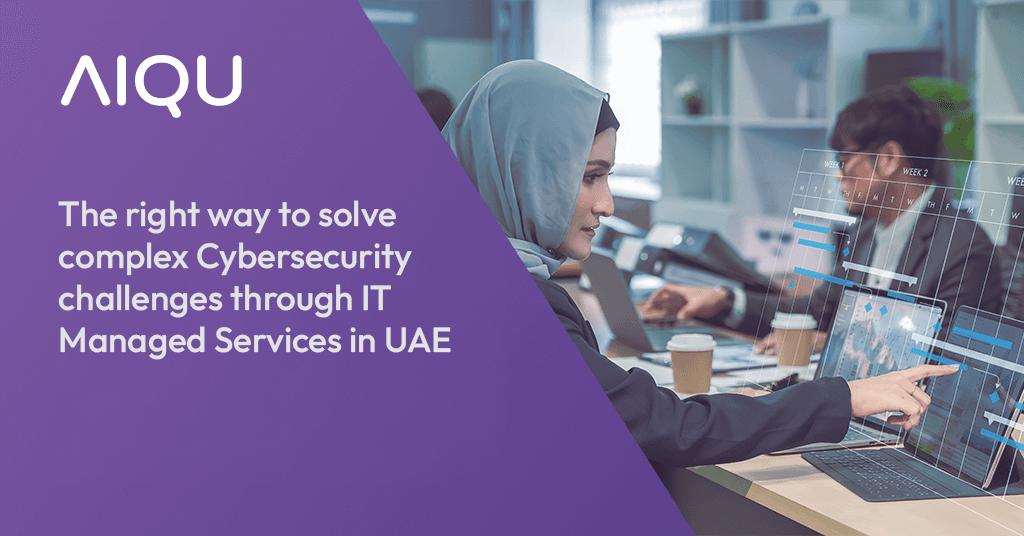
The right way to solve complex Cybersecurity challenges through IT Managed Services in UAE
Cybersecurity in the UAE has changed dramatically over the past few years, from being a niche technical issue to a key element in business resilience. As businesses in Dubai and Abu Dhabi speed up their cloud migrations and AI implementations, they realise the “attack surface”, the total number of points where a hacker can access a system, has grown very significantly.
At present, the dilemma for the leadership is no longer merely about buying the latest firewall. Rather, it’s a question of how to secure a diversified digital environment at a level that does not compromise the speed of business operations. Numerous organizations, IT Managed Services, have thus established a firm partnership with strategic digital transformation recruitment as a timely solution.
Why Cybersecurity Complexity Has Surged in 2026
The UAE’s digital landscape is now a web of interconnected platforms. Financial services integrate with government identity portals, retail chains rely on real-time IoT logistics, and healthcare providers manage sensitive patient data across multi-cloud environments.
This level of connectivity brings two major risks:
- Layered Vulnerabilities: A weakness in a small third-party API can provide a “side door” into your entire enterprise network.
- Velocity Risks: When a company pushes for a rapid digital transformation hire to meet a project deadline, security protocols can sometimes be rushed, leading to misconfigurations that stay hidden until a breach occurs.
Cybersecurity can no longer be a final step in a project. It must be the foundation upon which the project is built.
The Role of IT Managed Services as a Governance Backbone
Many companies still consider IT Managed Services as a mere outsourcing of helpdesk operations. But in 2026, these services become cybersecurity’s governance backbone.
A strong Managed Services framework offers:
- Unified View: Instead of using different set of tools, the management obtains a single “dashboard” view of all the threats and compliance statuses.
- Continuous Care: Through round-the-clock Security Operations Centers (SOC), managed providers identify behavioral anomalies, such as a login from a strange location, well ahead of those incidents turning into a major breach.
- Compliance with regulations: Local laws such as NESA and the latest data sovereignty statutes in UAE are incorporated into the managed service model thus, the company is always audit-ready.
The Talent Gap: Why Recruitment Strategy is a Security Asset
Technology is only as good as the people managing it. One of the biggest risks facing UAE firms is the talent gap. There is a high demand for cloud security architects and threat analysts, but a limited supply of experts who truly understand the local regulatory and technical landscape.
This is where digital transformations recruitment agencies in UAE have become vital. They do more than just fill seats; they help organizations build a “Security-First” culture.
Leveraging Digital Transformations Hiring Services
Leading enterprises no longer hire for “IT support” in isolation. They use specialized digital transformations hiring services to find engineers who have security in their DNA. These are professionals who understand how to build “Self-Healing” networks and automated response protocols.
When a company initiates a digital transformation hire, the recruitment process should vet for:
- DevSecOps Experience: Is the candidate competent in embedding security steps into the software development pipeline?
- Cloud Governance: Are they familiar with the shared responsibility model of major cloud providers?
- Local Compliance Knowledge: Are they familiar with UAE data protection standards?
Integrating Security into the Transformation Lifecycle
To solve complex security challenges, you must stop treating security and innovation as two different departments. They must work as one.
By working with digital transformations recruitment agencies, a business can embed security specialists directly into its innovation squads. This ensures that every new app or cloud migration is secure by design. If you wait until the end of a transformation project to “add security,” you are essentially trying to install a home security system while the house is already on fire.
Why UAE Enterprises are Adopting Managed Frameworks
The UAE’s 2026 regulatory environment is unforgiving of payroll issues, data leaks, or operational downtime. Boards now demand measurable data on risk.
IT Managed Services provide the structural control that internal teams often struggle to maintain during periods of hyper-growth. These providers offer:
- Standardized Response: Every incident follows a pre-defined playbook, reducing the “panic factor” during a threat.
- Scalability: As you launch new digital products, your security scales with you automatically.
- Advanced Triage: AI-driven tools help managed providers filter through thousands of daily alerts to find the one true threat that matters.
The Synergy Between Talent and Managed Technology
Resilience is not something you achieve once and for all; rather, it is about always being prepared. To be in such a state, your technology stack and your workforce should complement each other perfectly.
This is why digital transformations recruitment agencies are shifting their focus. They are no longer just looking for developers; they are looking for “Transformation Leaders” who can manage the relationship between in-house talent and outsourced managed services.
If your digital transformation recruitment strategy focuses purely on speed and ignores the defensive capability of the hire, you are building a fragile business. The most resilient UAE companies in 2026 are those that treat their recruitment partners and their IT managed service providers as two sides of the same coin.
Conclusion
Certainly, you cannot solve a complex cybersecurity challenge in the UAE by simply finding a “silver bullet” technology. Rather, it is a matter of developing an integrated system that incorporates:
- Structured IT Managed Services for 24/7 governance and oversight.
- Strategic Digital Transformation Recruitment to get the talent on board right.
- Executive Oversight that regards security as a key business pillar.
With a digital economy running 24/7, being “unhackable” shouldn’t be your target – that’s an illusion. Instead, you have to be able to recover quickly from a breach. Having your innovations safeguarded through professional managed services and an intelligent digital transformation recruitment strategy keeps your company in a position to not only survive a crisis but come out even stronger afterwards.
Frequently Asked Questions
1. What makes managing cybersecurity more difficult in the UAE today?
The combination of AI and cloud service has led to a rapid change in human lifestyles accelerating the complexity of systems. Since there is more data flowing through more platforms, there are more opportunities for a malicious attacker to exploit a vulnerability.
2. How do IT Managed Services facilitate digital transformation?
By removing the “heavy lifting” of daily security and maintenance from the internal team, thus allowing the developers to concentrate on innovation without having to worry about the basics.
3. What should I consider in digital transformations recruitment agencies in UAE?
First of all, they should be able to locate a technical understanding of the staff members. They need to be able to evaluate not only the candidate’s grasp of innovation (how to build) but also security (how to safeguard).
4. Is it possible to depend solely on cybersecurity technology?
Absolutely not. Even the most effective AI tools require human supervision. By leveraging digital transformations hiring services, a “human-in-the-loop” model can be maintained whereby security stays functional, adaptable and smart.
5.What is the impact of a digital transformation hire on long-term security?
If you bring the right kind of people in at transformation time, then security doesn’t become an add-on, a costly (and frequently ineffective) one at that, but rather a baseline feature of the new systems.